

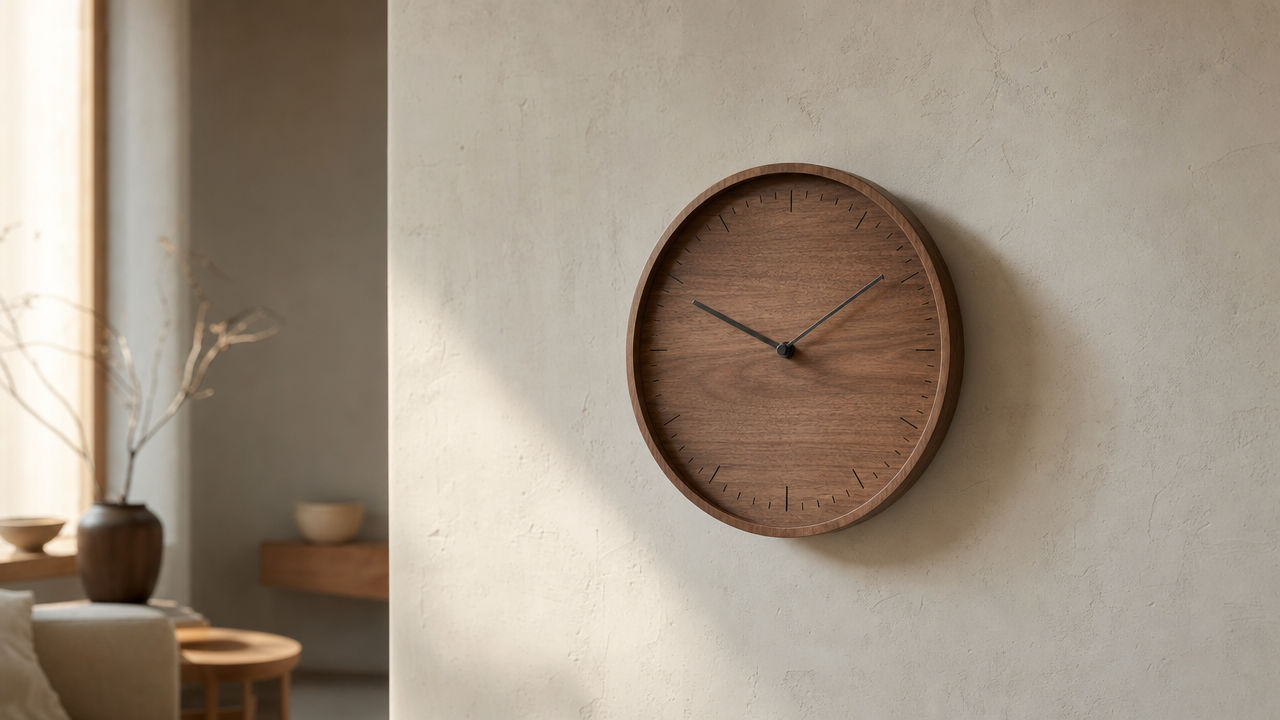
A wooden wall clock in Lithuania comes from one of four kinds of seller. A workshop that makes them, such as Woodsea or Samana Samana. An interior and decor specialist, such as Decotoma or Antsienos. A homeware retailer, such as Lizeja or IKEA. Or a marketplace and price comparison site, such as Pigu.lt, Kaina24.lt or Kainos.lt, which pools listings from all of them.
Across the Lithuanian pages read on 2026-08-18, the clocks that name their wood on the page run from EUR 37.00 to EUR 119.00. Below that sits the general wall clock category, where the material is not stated. Three things decide the purchase before price: whether the face is solid wood or a wood layer on a board, how big the dial is, and what movement is fitted.
Where do you buy a wooden wall clock in Lithuania?
Woodsea and Samana Samana are Lithuanian workshops. Decotoma and Antsienos are interior and decor specialists that publish the build on the product page. Lizeja and IKEA carry the cheap end of the general clock category. Pigu.lt, Kaina24.lt and Kainos.lt pool listings from all of them onto one screen. Each answers a different question.
| Where you buy | Named examples | Price on 2026-08-18 | What those pages publish | Suits |
|---|---|---|---|---|
| Lithuanian workshop | Woodsea, Samana Samana | EUR 112.49 to 119.00, with the Woodsea oak clock currently reduced to EUR 98.99 | Size in centimetres, the material, made in Lithuania, and a production or delivery time | A clock chosen as an object, from a named maker |
| Interior and decor specialist | Decotoma, Antsienos | EUR 37.00 on the Antsienos clock read here, EUR 54.00 to 65.00 across Decotoma's collection | Construction in millimetres, dial diameter and mechanism type, with 104 clocks in one Decotoma collection | Choosing by design with the build stated |
| Homeware and furniture retailer | Lizeja, IKEA | EUR 2.00 on the one IKEA clock read here, EUR 9.89 to 34.90 across Lizeja's 52 wall clocks, with no listing read on either site naming a wood | Diameter and mechanism at Lizeja; at IKEA a full material breakdown, which on the EUR 2.00 TROMMA lists plastic throughout | A working clock for a room nobody sits in |
| Marketplace and price comparison | Pigu.lt, Kaina24.lt, Kainos.lt | Varies by offer | Listings pooled from many sellers, with the material as whatever the original seller wrote | Seeing the whole market on one screen before choosing |
Woodsea sits on the workshop rung. Its wall clock collection describes the two clocks in it as "Premium wooden wall clocks made in Lithuania. Natural hardwood timepieces adding warmth & character to any room". Both the oak wall clock and the Dunes design list at EUR 112.49, and the oak one was reduced to EUR 98.99 on 2026-08-18. Both are published as 35 x 35 x 2 cm and both use a silent movement.
How much does a wooden wall clock cost, and what does each price buy?
A wooden wall clock with the wood named on the page costs EUR 37.00 to EUR 119.00 in Lithuania. Below that sits the general wall clock category. That runs from EUR 2.00 on the one IKEA clock read here to EUR 34.90 across Lizeja's 52 wall clocks, where the listings publish a diameter and a mechanism and leave the material unstated.
| Price on 2026-08-18 | Seller and clock | What the seller states it is | Size the page publishes | Movement |
|---|---|---|---|---|
| EUR 9.89 to 34.90 | Lizeja, 52 wall clocks in the category | No material named in the listings read; a Kurren at 25 cm opens the category at EUR 9.89, a PEARL at 32 cm closes it at EUR 34.90 | "skersmuo 30cm" on the Kurren at EUR 13.99 | "tylus bėgantis mechanizmas" |
| EUR 37.00 | Antsienos, Horizontalus ąžuolas | "pagamintas iš 3 mm ąžuolo medienos ir 10 mm MDF plokštės", 3 mm oak over a 10 mm MDF board | "Laikrodžio ciferblato skersmuo: 33 cm" | "Tyliai tekantis QUARTZ MOVEMENT, jokio tiksėjimo efekto" |
| EUR 54.00 to 65.00 | Decotoma, 104 clocks in the collection | Boards covered in natural wood veneer, oak and walnut among them, with velvet fabric versions in the same collection | 430 x 430 mm on the standard models, 550 x 520 mm on the largest | A silent movement, stated for the collection |
| EUR 112.49, oak currently EUR 98.99 | Woodsea, oak and Dunes | "Natural hardwood timepieces", made in Lithuania | 35 x 35 x 2 cm published on both | Silent movement on both |
| EUR 119.00 | Samana Samana, Laikrodis LIETUVA | "ąžuolo lukštais padengta medienos plokštė", a wooden board covered in oak veneer | "41 x 41 cm" | "kvarcinis (tylus), rodyklė slenka iš lėto ir neskleidžia garso" |
The ladder does not sort by construction, and that is the thing worth knowing before shopping by price. Samana Samana at EUR 119.00 is a veneered board, and so is Decotoma at EUR 54.00 to 65.00. Antsienos at EUR 37.00 is a board build too, and the only one of the three that publishes a thickness: 3 mm of oak on a 10 mm board. Size, design and who made it move the price as much as material does.
Two kinds of wait are published at the top of the ladder. Samana Samana states "Sieninio laikrodžio gamyba užtrunka 7-10 d.d.", meaning 7 to 10 working days of production. Antsienos states "Pristatysime per 10 d.d.", delivery within 10 working days. Availability travels with those waits too: the Samana Samana clock read "Neturime", out of stock, on the check date. A Woodsea clock ships from stock. The same two designs also exist as the Table clock made of oak and the Table clock Dunes at EUR 61.49, both published as 11.5 x 11.5 x 5 cm, the oak version made "from carefully selected solid oak wood". Buying the pair and putting one clock in each of two rooms works well.
Is it solid wood or a wood face on a board, and how do you tell?
A wooden wall clock is one of two builds, and the seller's own page is where you tell them apart. Either a thin layer of wood is bonded to a board, which is what "lukštas", veneer and MDF describe in a listing. Or the face is hardwood right through. Both are legitimate objects at legitimate prices. The difference is what you are paying for, and both keep time the same way.
The Lithuanian sellers priced here state their build in their own listing text. Antsienos publishes "pagamintas iš 3 mm ąžuolo medienos ir 10 mm MDF plokštės" on its Horizontalus ąžuolas at EUR 37.00, so a buyer knows there are 3 mm of oak on a 10 mm board before ordering. Decotoma describes its collection as boards covered in natural wood veneer, oak and walnut among them, at EUR 54.00 to 65.00, without putting a thickness on the veneer. Samana Samana describes its Laikrodis LIETUVA at EUR 119.00 as "ąžuolo lukštais padengta medienos plokštė", also without a thickness. Woodsea's collection page calls its two clocks natural hardwood timepieces made in Lithuania.
Put those pages side by side and the difference is easy to state. A board build gives a flat, stable face and puts the money into the design and the grain you see. It is the reason a 43 cm clock can cost EUR 54.00. A hardwood face puts the money into the material, so what hangs on the wall is a section of one wood. Neither build changes how the clock keeps time, because the movement behind the face is a separate part bought in. Neither build is a compromise at its own price.
What follows for a buyer is one check. Find the construction line. Where a listing has none, ask the seller which of the two builds it is before paying. Antsienos, Decotoma, Samana Samana and Woodsea all answer it in their own listing text, and any workshop that makes its own clocks answers it in a sentence.
What size wall clock does a room need?
Size a wall clock against the furniture under it. Newgate, a British clock maker, publishes the proportion to work to: "aim for it to take up roughly one-half to two-thirds of the width of the piece of furniture below". Its bands are 25 to 35 cm for "small walls or narrow spaces", 40 to 60 cm above "a console or fireplace", and "70cm and above" for a large feature wall. The same page leaves the door open above the proportion rule, since large clocks in its account "are often used to add drama without clutter".
| Where it hangs | Newgate's band, published as a diameter | Clocks near that size among the sellers priced here, squares placed by their edge |
|---|---|---|
| Small wall or narrow space, a kitchen, a hallway, a home office | 25 to 35 cm | Lizeja's Kurren at 25 cm and at 30 cm, Antsienos at a 33 cm dial, Woodsea at a 35 cm face |
| Above a console, a fireplace or a sideboard, a medium wall | 40 to 60 cm | Samana Samana at 41 x 41 cm, Decotoma at 430 x 430 mm and 550 x 520 mm |
| A large feature wall in a living room | 70 cm and above | Larger than anything the sellers priced here sell, and Newgate's own drama argument is the case for going there |
The unit convention in that table is worth spelling out, because two clocks with the same published number can read at different sizes on the wall. Newgate publishes diameters, and so does Antsienos with its 33 cm dial, meaning the circle you read the time from. Woodsea, Samana Samana and Decotoma publish the outside dimension of a square. A 35 cm square clock and a 35 cm round clock do not cover the same wall.
Measure the furniture first. Take one-half to two-thirds of that width, then shop inside the band it gives you. A 150 cm sideboard points at 75 to 100 cm, which is the feature wall bracket. A 60 cm run of kitchen wall between two cupboards points at 30 to 40 cm, which is where most of the Lithuanian wooden clocks sit.
Silent or ticking: which movement, and does it matter?
Ask for a silent movement, and expect to find one at every price. A clock runs on one of two quartz movements. A step movement jumps the second hand once a second and makes a soft tick. A continuous sweep movement makes none. Esslinger, a United States supplier to watchmakers and clockmakers, describes the second type as "continuous sweep for no ticking sound". It lists both in the Seiko mini quartz family running on a standard AA battery, and quotes accuracy "within +/-15 seconds per month" for the Seiko Precision Mini Quartz AA movement.
The Lithuanian pages publish the silent version across the whole price range. Lizeja's Kurren models at the bottom state "tylus bėgantis mechanizmas". Antsienos states "Tyliai tekantis QUARTZ MOVEMENT, jokio tiksėjimo efekto" at EUR 37.00. Decotoma states a silent movement for its 104-item collection at EUR 54.00 to 65.00. Samana Samana states "kvarcinis (tylus), rodyklė slenka iš lėto ir neskleidžia garso" at EUR 119.00. Woodsea's wall clocks use a silent movement.
That is worth knowing before paying for quiet. A silent movement is available at the bottom of this market, so the extra money at the top of the ladder goes into the face, the size and the maker. The movement still decides a purchase in one case: the listing that says nothing about it. A photograph cannot show which type is fitted. In a kitchen a step movement goes unnoticed. In a bedroom at night it is the thing people return a clock over, so that is the listing to ask about before ordering.
Which wood suits a wall clock?
Oak is named on every wooden clock page priced here, and choosing between woods on a wall clock is a colour decision. Antsienos names oak on its Horizontalus ąžuolas. Samana Samana names oak veneer on its Laikrodis LIETUVA. Decotoma names oak and walnut veneers among the finishes in its collection. Woodsea sells both of its wall clock designs in oak.
The material of a wall clock does no work. It takes no knife, no heat and no water, so hardness and density decide nothing. That is what separates this purchase from choosing a chopping board. What the wood decides is how the face reads in the room: oak light and open grained, walnut darker and quieter.
The one condition worth attaching is where the clock hangs. Wood moves with the moisture in the air whatever it is made into. A wall over a hob, a bathroom wall or an unheated hallway is harder on a wooden clock than a living room wall.
Where do you hang a wall clock, and how high?
Hang the centre of the clock at eye level. Merit Home, a British homeware retailer, publishes the figure as the centre of the clock "between eye level and chest level", approximately 57 to 60 inches, which is 145 to 152 cm from the floor. It notes that in smaller rooms such as kitchens a clock "may be hung slightly higher to avoid obstructions".
Two adjustments come off that starting point. Over a sofa or a console, line the clock up with the middle of the furniture and take its width from Newgate's proportion, one-half to two-thirds. In a room where the clock is read standing up, a kitchen or a hallway, go higher than an eye level measured while seated.
Fixing is the last step and it depends on the wall. A single hook or nail carries a clock of this size on a solid wall. Plasterboard wants a proper plasterboard fixing. Ask the seller what the back of the clock is set up for before drilling, because the fitting varies between makers.
What battery does a wooden wall clock take, and how long does it last?
Expect a single AA battery. IKEA publishes it plainly on its TROMMA wall clock: "Baterijos paduodamos atskirai. IKEA rekomenduoja įkraunamąsias baterijas LADDA. Laikrodis veikia ir su šarminėmis baterijomis (AA, 1 vnt.)". That means batteries are sold separately, rechargeable LADDA cells are recommended, and the clock runs on one alkaline AA. Esslinger lists the Seiko mini quartz movements behind most wall clocks as AA battery movements too.
Esslinger publishes no battery life figure for these movements. So the practical signal is behaviour: a clock that starts losing minutes wants a new cell before it wants a repair. The battery itself is a standard consumable sold in any shop.
One thing to settle at the counter is whether a battery is in the box. A clock sold without one has to be opened before it can be hung.
Is a handmade Lithuanian clock worth the difference over a marketplace one?
A EUR 9.89 clock and a EUR 98.99 clock both tell the time silently. The difference is the object on the wall and who made it, and that points both ways depending on the room.
The cheap end covers a lot of ground. Lizeja lists 52 wall clocks between EUR 9.89 and EUR 34.90, a 30 cm Kurren at EUR 13.99 among them, all with a silent mechanism stated in the listing. Any of them covers a utility room, a garage or a rented kitchen completely. Nothing about the higher rungs makes those clocks keep worse time. What they do not tell you is what they are made of, and that matters only if you care what is on the wall.
The workshop end attaches the money to something specific. Woodsea publishes a 35 x 35 x 2 cm face in oak, made in Lithuania, in two designs, with a silent movement, shipping from stock, at EUR 112.49 with the oak one currently reduced to EUR 98.99. Samana Samana at EUR 119.00 makes each clock to order in 7 to 10 working days. Decotoma states that its collection is made in Lithuania at EUR 54.00 to 65.00, which puts a Lithuanian made clock inside the mid band as well. So among the sellers read here, Lithuanian production starts at about EUR 54.00, and the step above it buys hardwood, size and a specific design.
Buy at the bottom of the ladder when the clock is furniture for a room nobody sits in. Buy at the top when the clock hangs where people look, or when it is going to somebody as a present. A wall clock is a common housewarming gift, and it comes with one condition worth checking first: a tenant may not be able to drill. What to give instead, and the rest of the wooden gift range by budget, is in the Woodsea guide to housewarming gifts and equipping a new kitchen.
Does a wooden wall clock need any care?
Very little. Dust it, and keep it off a wall that is damp, hot or unheated.
The air around it matters more than the surface. Pioneer Millworks, a maker of reclaimed wood flooring and panelling, "recommends keeping the RH (Relative Humidity) in the 35%-65% range in any indoor space where our wood flooring & paneling is, or will be, installed". That is the same band any solid wood object wants.
Woodsea's own product care guide covers boards and kitchen tools, where washing, drying and monthly oiling apply. A wall clock skips that routine entirely. The one habit worth keeping is choosing the wall in the first place: away from a hob, out of a bathroom, and out of an unheated space.
FAQ
Where can you buy a wooden wall clock in Lithuania?
From four kinds of seller. Lithuanian workshops such as Woodsea and Samana Samana sell clocks made in the country at EUR 112.49 to 119.00, with the Woodsea oak clock currently reduced to EUR 98.99. Interior and decor specialists such as Decotoma and Antsienos sell design ranges with the build published, at EUR 37.00 on the Antsienos clock read here and EUR 54.00 to 65.00 across Decotoma's collection. Homeware retailers such as Lizeja and IKEA cover the cheap end without naming a wood. Marketplaces such as Pigu.lt, Kaina24.lt and Kainos.lt pool all of them onto one screen.
How much does a wooden wall clock cost in Lithuania?
A wooden wall clock with the wood named on the page costs EUR 37.00 to EUR 119.00. On the pages read on 2026-08-18 that runs from EUR 37.00 at Antsienos, through EUR 54.00 to 65.00 at Decotoma, to EUR 112.49 at Woodsea with the oak design reduced to EUR 98.99, and EUR 119.00 at Samana Samana. Below EUR 37.00 sits the general wall clock category, EUR 9.89 to 34.90 across Lizeja's 52 clocks, where the material is not stated.
Is it solid wood or veneer, and how do you tell?
Read the construction line on the seller's own page. Words like "lukštas", veneer and MDF describe a thin layer of wood bonded to a board. Antsienos publishes "3 mm ąžuolo medienos ir 10 mm MDF plokštės" on its EUR 37.00 clock, which is 3 mm of oak on a 10 mm board. Samana Samana describes its EUR 119.00 clock as "ąžuolo lukštais padengta medienos plokštė", an oak-veneered board. Woodsea calls its two clocks natural hardwood timepieces. Where a listing carries no construction line, ask before paying.
What size wall clock do I need?
Size it against the furniture under it. Newgate publishes the proportion as roughly one-half to two-thirds of the width of the piece below. Its bands are 25 to 35 cm for a small wall or narrow space, 40 to 60 cm above a console or fireplace, and 70 cm and above for a large feature wall. Check the unit before comparing: a dial diameter and the outside dimension of a square are different measurements, and a 35 cm square does not cover the same wall as a 35 cm circle.
Are wooden wall clocks silent?
Most sold in Lithuania are, and a silent movement is available at every price here. Lizeja states "tylus bėgantis mechanizmas" on its cheapest models, Antsienos states "Tyliai tekantis QUARTZ MOVEMENT" at EUR 37.00, Decotoma states a silent movement across its collection, and Samana Samana states "kvarcinis (tylus)" at EUR 119.00. Woodsea's wall clocks use a silent movement. The listing to ask about is the one that says nothing, because a photograph cannot show which movement is fitted.
Which wood is best for a wall clock?
Wood choice on a wall clock is a colour decision. A wall clock takes no knife, no heat and no water, so density and Janka hardness decide nothing. Oak, light and open grained, is named on every wooden clock page read here. Walnut reads darker and quieter, and Decotoma names it among its veneers. What does matter is the wall: keep a wooden clock away from a hob, out of a bathroom and out of an unheated space.
How high should you hang a wall clock?
With its centre at eye level. Merit Home publishes that as "between eye level and chest level", approximately 57 to 60 inches, which is 145 to 152 cm from the floor, and notes that in a kitchen a clock may be hung slightly higher to avoid obstructions. Over a sofa or console, line it up with the middle of the furniture and take its width from Newgate's one-half to two-thirds rule.
What battery does a wall clock take?
A single AA in most cases. IKEA states on its TROMMA clock that batteries are sold separately, that it recommends rechargeable LADDA cells, and that the clock runs on one alkaline AA. Esslinger lists the Seiko mini quartz movements behind most wall clocks as AA movements and quotes accuracy within plus or minus 15 seconds per month for the Seiko Precision Mini Quartz. No battery life figure is published for them, so treat a clock losing minutes as a battery to change rather than a fault.
Is a handmade Lithuanian wall clock worth the extra money?
It depends on the room. A EUR 9.89 clock and a EUR 98.99 clock both tell the time silently, and Lizeja's 52 clocks between EUR 9.89 and EUR 34.90 cover a utility room or a garage completely. What the cheap listings do not tell you is what the clock is made of. Among the sellers read here, Lithuanian production starts at about EUR 54.00 at Decotoma, and the step above that buys hardwood, size and a specific design. Buy at the top when the clock hangs where people look, or when it is a present.
Does a wooden wall clock need any care?
Very little. Dust it, and choose the wall carefully. Wood moves with the moisture in the air, and Pioneer Millworks recommends keeping indoor relative humidity between 35 and 65 percent in any space where its wood flooring and panelling is installed, which is the same band a solid wood clock wants. Keep it away from a hob, out of a bathroom and out of an unheated hallway. The washing, drying and oiling routine that applies to boards and kitchen tools does not apply to a clock.
About Woodsea
Woodsea is a Lithuanian workshop making handmade wooden kitchenware and home objects: cutting, serving and butcher boards, knife holders, grinders, wall and table clocks, candlesticks and key holders, in oak, ash, walnut, maple and pine. Orders are processed within 1 to 2 business days and ship from stock. The wall clocks are in the wall clock collection and the rest of the home range is in the interior collection.