

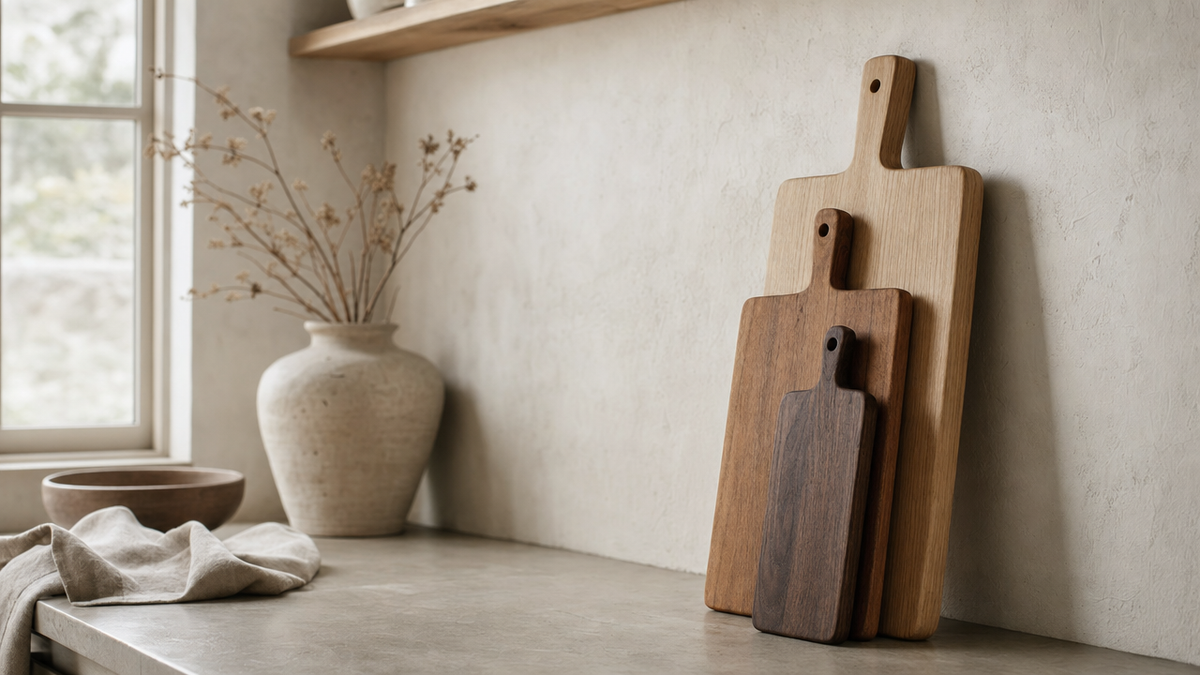
Choose a wooden cutting board on four things, in this order: how well the wood was dried, how thick it is, which wood it is, and whether the size fits the way you cook. A board made from properly dried hardwood at 2 cm or more sits flat, takes knife work without opening up, and can be sanded back to a fresh surface several times. Thermally treated wood is the one exception to that thickness, because it moves far less with damp air and holds its shape at 1.5 cm. Woodsea puts the difference between a cheap board and a good one in four places: the wood, how it is put together, how it is finished, and how long it lasts. Cheaper boards use softer or less well dried wood and are cut thinner, so they bend, crack and start rocking on the worktop sooner.
A cutting board is one of the few things in a kitchen you can bring back to new instead of throwing away. Drying and thickness decide whether that is possible at all. Most buyers pick the wood first, but the wood mainly settles how the board feels under a knife and how it looks after a year.
What separates a cheap wooden cutting board from a good one?
Four things: the wood itself, how it is put together, how the surface and edges are finished, and how many years the board stays usable. That is Woodsea's answer, and you can check or ask about every one of them before you pay. Thickness sits underneath all four, and it is the one you can measure yourself.
| What to look at | Cheaper board | Better board |
|---|---|---|
| Wood | Softer species, or stock that was dried less thoroughly | Carefully selected hardwood, properly dried |
| Thickness | Thinner | Thicker, and more stable because of it |
| Behaviour in use | Bends, cracks and starts rocking on the worktop sooner | Holds its shape and stays flat |
| Surface and edges | More roughly worked | Precisely sanded, surface prepared for contact with food |
| End of life | Replaced when it wears | Sanded and renewed, serves for many years |
Source: Woodsea, on what changes between price levels.
Rocking is the most useful thing on that list, because it takes three seconds to test in a shop. A board that rocks on a flat worktop has already moved once, before it has met a knife or a sink.
That price gap costs you most on the board you cook on every day.
Why does the drying of the wood decide how long the board lasts?
Drying decides how long a board lasts, because a board is a wide flat panel, and that is the shape that shows wood movement worst. Wood that still holds too much water keeps shrinking after it reaches your kitchen. Wood dried too far the other way splits.
The target is narrow. Wagner Meters puts the right moisture level for indoor wood at 6 to 8 percent, against 9 to 14 percent for outdoor use. It describes what goes wrong in both directions: too much water and wood bends, swells or rots; too little and it cracks, splits or gets weak. A board rushed through drying spends its first year in your kitchen finishing the job, and people blame the washing-up for the bending and cracking that follow.
You cannot read moisture off a product photo, so buy on the clues you can see. A seller who states the wood, the exact size and the weight is describing a specific piece of timber. A listing that just says "wood" is describing a price. Weight is the quiet clue. Woodsea's small Classic board in oak is 25 x 15 x 1.5 cm and 420 g, and the large one is 40 x 25.5 x 2 cm and 750 g. A board the same size that weighs noticeably less is either softer wood or a thinner cut.

How thick should a wooden cutting board be?
For a board in untreated hardwood that you chop on daily, look for 2 cm or more. At 1.5 cm and below, an untreated board belongs to serving and light jobs. At 3 cm and above you are buying a chopping block that mostly stays out on the worktop. Thickness buys two separate things: steadiness now, and sanding life later.
| Thickness | What it suits | What it costs you |
|---|---|---|
| 1.5 cm, untreated hardwood | Serving, cheese, bread, fruit, a light second board | Least steady of the untreated thicknesses, least material to sand back |
| 1.5 cm, thermally treated hardwood | Daily chopping, including full-size boards | Same limited material to sand back, and a more brittle wood |
| 2 to 2.5 cm | The main daily board for most kitchens | Still light enough to lift, wash and stand up one-handed |
| 3 cm and above | Heavy chopping, bone-in meat, a board that lives on the worktop | Heavy to lift and wash, and priced accordingly |
Thermal treatment is what puts a 1.5 cm board into daily chopping. Heating wood until part of its structure breaks down leaves it taking up much less water afterwards, so it swells and shrinks far less as the air in a kitchen changes. Masoumi and Bond measured this across six hardwoods in BioResources in 2024. White ash improved the most, at 71.4 percent less swelling and 65.6 percent less shrinking than untreated stock. Those figures are for white ash in particular, and a board sold as thermo ash does not always say which ash it is. Less movement means less bending, and bending is most of what thickness protects a board against. Woodsea makes the same case on its Waterless board listing: "due to special thermal wood treatment, the boards are resistant to water, stains and deformation". That board is thermo ash and 1.5 cm in every size, up to a large at 46 x 33 x 1.5 cm and 1,100 g. The large size gives you a full chopping surface at a thickness the same wood untreated would struggle with.

There is a trade-off, and it is in the same research. Thermal treatment lowers bending strength and impact resistance, so the wood cracks more easily under a sudden blow. That is why the Virginia Tech Center for Forest Products Business says thermally treated wood is not recommended for load-bearing uses. Knife work is not a sudden blow, and a thermally treated board takes it at 1.5 cm. Chopping through bone and cleaver work are sudden blows, and that is what the 3 cm band is for.
Buyers underestimate the sanding part. A scarred board can be sanded flat and re-oiled, and how many times depends on how thick it is. Every millimetre of thickness is future board. How the sanding is actually done is in the Woodsea cutting board care guide.
General retail advice recommends 1 1/2 inches (about 3.8 cm) and up for heavy chopping, with about 2.5 cm as the everyday figure. European workshop boards run thinner. Woodsea's thin boards go from 1.5 cm on the small Classic to 3 cm on the large Chop-chop. Its heavy boards go above that: 4 cm on the grooved walnut butcher board, 4.5 cm on the Block and Edge boards, and 5 to 6 cm on the Woodstone ash and walnut. A thin board gives up some sanding life, and it gives up weight. Losing the weight is what protects it day to day: at 750 g the large Classic gets lifted, washed and stood on edge after every use, and that is what keeps a board flat. The large Chop-chop at 2,800 g is a board most people wipe where it stands.

Which wood is best for a cutting board: oak, ash, walnut, maple or pine?
For a board in daily use, pick a hardwood: oak, ash, walnut or maple. Pine and other softwoods are kind to blades and take deep cuts and dents quickly, which makes them a serving and light-duty choice. Maple sits at the top of the hardness scale of the group.
| Wood | Janka hardness (lbf) | Buy it for | Live with |
|---|---|---|---|
| Maple (hard maple) | 1,450 | The hardest of the group and the international reference board wood | A pale surface that shows stains sooner |
| Oak (white oak) | 1,350 | Hard, strong, long-lived, handles intense daily use | Open pores, so prompt drying and oiling matter more |
| Ash (white ash) | 1,320 | Hard and springy, a good all-round board | Behaves predictably, nothing special required |
| Walnut (European) | 1,220 | Softer than oak and ash, so kinder to knife edges, deep dark colour | Cuts show sooner on a dark surface, and it is the dearest of the four |
| Pine (Scots pine) | 540 | Serving, bread, cheese, light work, gentle on blades | Deep cuts and dents appear quickly under real chopping |
Janka figures: The Wood Database, white oak, white ash, English walnut, hard maple, Scots pine. The maple row rests on The Wood Database alone. Woodsea does not publish which maple or pine subspecies it buys, so the table uses the standard references, hard maple (Acer saccharum) and Scots pine (Pinus sylvestris).
One name in the Woodsea range is worth knowing before you shop. The board sold as "Cutting board - Pine" is made of maple, because Pine there is the name of the design. The Burned pine board is the one that is actually pine.
A lot of English-language advice tells buyers to avoid oak, on the grounds that it is open-grained and drinks water. The picture is more specific than that. White oaks, the group European oak belongs to, have their large pores plugged with tyloses. That is why The Wood Database rates white oak "very durable" and points to its use in boatbuilding and tight cooperage, the trade that keeps wine inside oak barrels. Red oaks do not have those plugs and behave differently. What stays true of any oak is that the pores are pronounced, so care matters more. In practice that means drying the board promptly after washing and oiling it on time.
The hygiene research does not settle the wood question either way. Hard maple is the reference wood in the United States Food Code, which allows "hard maple or an equivalently hard, close-grained wood" as a food surface for cutting boards, in the wording adopted in Minnesota. Dean Cliver's UC Davis work tested more than ten hardwoods against four plastics and hard rubber and found essentially no difference between the wood species. So pick your wood on hardness, colour and price. What actually changes hygiene is the state of the surface, and University of Maine Cooperative Extension applies the same test to every wood and every material: replace a board once it has deep grooves, cracks or heavy wear.
What size cutting board do you need for everyday cooking?
Most kitchens are covered by one main board around 40 cm long and one smaller board around 25 cm. The test is simple: the board has to be longer than your chef's knife, and deep enough that the whole edge stays on the wood. If chopping keeps spilling onto the worktop, the board is too small.
| How you cook | Board length | Example from the Woodsea range |
|---|---|---|
| Fruit, cheese, bread, small garnish work | 25 to 30 cm | Classic small, 25 x 15 x 1.5 cm, 420 g |
| Everyday cooking for a household | 30 to 45 cm, with about 40 cm the comfortable middle | Classic large, 40 x 25.5 x 2 cm, 750 g |
| Heavy chopping, whole chickens, big vegetable volumes | 45 cm and up | Chop-chop, large size 50 x 24 x 3 cm |
Those bands line up with general retail advice, which puts 12 to 16 inches, roughly 30 to 40 cm, as the most versatile everyday size, and 18 inches and up for frequent heavy chopping. A main board that is too small pushes people back onto whichever board is big enough, including the one they just used for chicken. So size decides hygiene as well as comfort.
How many cutting boards does a kitchen need?
Two boards cover most kitchens. Woodsea recommends one board for raw meat and poultry, and one for everything eaten raw or not cooked again. A separate board for every type of food is unnecessary, and one larger good board handles most daily work.
The United States Department of Agriculture draws the same line, advising one board for fresh produce and a separate one for raw meat, poultry and seafood. Michigan State University Extension gives the practical version: use one board for meat only and a different board for vegetables, and label or colour code them.
A third and fourth board rarely change anything, because the split that matters is raw meat against ready-to-eat. Spend the extra money on making the main board bigger and thicker. How to clean the meat board properly is in the care guide.
Wood, plastic, bamboo or glass: which cutting board should you buy?
For a board you will own for years, wood is the only one of the four you can resurface when it wears. Plastic and bamboo are consumables with a replacement point built in. Glass is a serving surface that damages knives.
| Material | Effect on knife edges | Can it be renewed | Typical replacement trigger | Entry price |
|---|---|---|---|---|
| Hardwood | Gentle, Janka 1,220 to 1,450 across the board hardwoods | Yes, sanded flat and re-oiled, limited by thickness | Cracks, mould, or grooves that cannot be cleaned | From EUR 17.49 in the Woodsea range |
| Plastic (HDPE) | Gentle | No | Deep grooves and cut marks, where Michigan State University Extension says bacteria can grow | A few euros |
| Bamboo (glued up from strips) | Harder on edges, Janka 1,410 to 1,610 against 1,220 to 1,450 for the board hardwoods | No, 16 mm on the IKEA APTITLIG leaves little to sand back | Coming apart at the glue lines, or grooves | EUR 8.99 for the IKEA APTITLIG, 45 x 28 cm |
| Glass, stone, ceramic | Damaging, the surface is far harder than knife steel | No | Rarely wears, though it is wearing your knives | Varies |
Sources: The Wood Database on bamboo, which notes that bamboo is a grass, that boards are "formed by gluing smaller bamboo strips either in a horizontal or vertical orientation", and that bamboo carries 0.5 to 4.0 percent silica "found almost entirely in the outermost layers". University of Maine Cooperative Extension on board materials, which rates glass, marble and stone as easy to clean while noting a hard surface "can dull knives quickly", and recommends replacing boards with deep grooves, cracks or heavy wear. IKEA price and 16 mm thickness checked on ikea.com/lt on 2026-08-12.
Bamboo is the interesting case. It is sold as the green upgrade over plastic, and it is genuinely hard and cheap. Hard and cheap both work against it for a board you plan to keep. On the Janka scale bamboo runs 1,410 to 1,610 lbf against 1,220 to 1,450 for the board hardwoods, so a knife edge meets a harder surface every time it lands. IKEA markets the APTITLIG as gentle on knives, and the hardness figures are the reason to treat that claim carefully. The second limit is how thin it is. The APTITLIG is 16 mm, and thickness sets how many times any board can be sanded back. A hardwood board can be sanded flat until it gets too thin to stay steady.
What should you check before buying a wooden cutting board?
Check six things. Most of them take half a minute on a product page or in a shop.
- The wood is named, with the size and the weight. A listing that says oak, ash, walnut, maple or pine and gives the numbers is describing a specific piece of timber. Size plus weight together tell you the thickness and hint at how dense the wood is. "Wood" or "hardwood" is not a specification.
- The thickness matches the use. 2 cm and up in untreated hardwood for the board you cook on, 1.5 cm for serving, and 1.5 cm for daily chopping when the wood is thermally treated.
- The board sits flat. Press each corner on a level surface. A new board that rocks has already moved.
- The surface and the edges are properly finished. Run a hand over the face and along the edges. Precise sanding and finished edges together make up one of the four differences Woodsea names between price levels, and rough edges are where run-off collects.
- The finish is stated as food-safe. Woodsea's board pages list a food-safe finish, and the workshop finishes its boards with a certified mineral oil.
- The maker publishes care instructions. Someone who writes down the routine expects the board to last long enough to need it.
Published care instructions are the check most buyers skip, and they cost nothing to look for. Woodsea publishes the routine on every board listing and in that guide.
How much should a wooden cutting board cost?
A handmade hardwood board that will last for years starts at EUR 17.49 for a small everyday size in the Woodsea range and goes past EUR 100 for large statement boards in walnut. The cheap end sits below EUR 10. IKEA's APTITLIG bamboo board, 45 x 28 cm, was EUR 8.99 on ikea.com/lt on 2026-08-12, about half the price of the smallest handmade oak board.
| Board | Wood | Price from |
|---|---|---|
| Classic | Oak | EUR 17.49 |
| Waterless | Thermo ash | EUR 24.99 |
| Burned pine | Pine | EUR 29.99 |
| Chop-chop, with leather handle | Oak | EUR 32.49 |
| Woodstone ash | Ash | EUR 44.99 |
| Woodstone oak | Oak | EUR 74.99 |
| Woodstone walnut | Walnut | EUR 187.50 |
Prices from the Woodsea cutting board collection on 2026-08-12, where the range runs from EUR 17.49 on the small Classic and the small Shapeless to EUR 350.00 on the Woodstone king medium.
Do the maths over time rather than at the till. A plastic board replaced when it grooves, and a bamboo board replaced when it comes apart, are repeat purchases. A hardwood board that was dried properly, kept out of standing water and sanded once or twice in its life is one purchase. The running cost is a jar of Wood Butter at EUR 14.50, used about once a month.

Is an expensive wooden cutting board worth the money?
For a board you cook on every day, yes. The extra money buys properly dried hardwood, more thickness, and finished surfaces and edges. Those three decide whether the board stays flat and whether it can be sanded back at all. For a board that comes out at weekends, a cheap one is a reasonable buy. How long any board lasts also depends on how it gets treated, so price buys the board a better start and use decides the rest.
Is a wooden cutting board a good gift, and which one should you pick?
A wooden board makes a good gift when it is the size the person is missing, and that is usually a large one. People buy themselves small boards and put off the big purchase. So a 40 cm or larger board in oak, ash or walnut lands better than another small one. After that, the choice follows the person.
| Who it is for | What to give | Price |
|---|---|---|
| Cooks daily, owns only small boards | Waterless in thermo ash, large size 46 x 33 x 1.5 cm, 1,100 g | EUR 64.99, or EUR 24.99 for the small size |
| Hosts more than they cook | Cheese board with knives, oak or walnut, 42 to 75 cm long, cheese knives included | From EUR 62.50 |
| Setting up a kitchen, or a gift that should arrive as a set | Native Oak Essentials bundle, or The Minimalist Oak Set bundle | EUR 94.59 and EUR 138.09 |
Prices from the Woodsea cutting board collection and the linked product pages on 2026-08-12.
For someone who cooks daily and wants weight in the hand, the large Classic in oak at 40 x 25.5 x 2 cm and 750 g is the other safe answer, in a range starting at EUR 17.49. If the person puts food on the table more often than they chop it, a serving board suits them better.
Timing is easier than gift buyers expect. Woodsea boards ship from stock, with 1 to 2 business days of processing and delivery of 2 to 5 working days inside Lithuania and 5 to 7 internationally. A board bought a week ahead arrives in time. Engraving is not part of the Woodsea range. Marking on a cutting face gets cut through in normal use anyway, so personalisation on boards usually goes on the back or on a handle.
A jar of Wood Butter alongside the board covers the monthly oiling.
FAQ
How thick should a wooden cutting board be?
At least 2 cm in untreated hardwood for a board you chop on daily, 1.5 cm for serving and light work, and 3 cm and above for heavy chopping. Thermally treated wood is the exception, because it takes up much less water and moves less with it, so it holds its shape at 1.5 cm in full-size boards. Woodsea's Waterless in thermo ash is 1.5 cm in every size, up to 46 x 33 cm. How many times a board can be sanded flat and re-oiled depends on its thickness.
Is oak a good wood for a cutting board?
Yes. Oak is hard, strong and long-lived and handles intense daily use, with a Janka hardness of 1,350 lbf for white oak. Its pores are pronounced, so care matters more on oak: dry the board promptly after washing and oil it on time. In white oaks those pores are plugged with tyloses, which is why the same wood is used for wine barrels.
Which is better for a cutting board, oak or walnut?
Oak is harder at 1,350 lbf against 1,220 lbf for European walnut, so it resists denting better under heavy daily use. Walnut is softer, which makes it gentler on knife edges, and its dark colour hides stains while showing fresh cuts sooner. Walnut also costs considerably more: in the Woodsea range, oak boards start at EUR 17.49 and the walnut Woodstone starts at EUR 187.50.
Is a bamboo cutting board better than a wooden one?
Bamboo is cheaper and harder than the board hardwoods, which also makes it harder on knives, and it cannot be renewed. The Wood Database puts bamboo at 1,410 to 1,610 lbf on the Janka scale, comparable to or harder than the board hardwoods at 1,220 to 1,450, with 0.5 to 4.0 percent silica "found almost entirely in the outermost layers". A bamboo board is glued up from strips and sold thin, 16 mm on the IKEA APTITLIG, and thickness is what sets how many times a board can be sanded flat and re-oiled.
Are glass cutting boards bad for knives?
Yes. University of Maine Cooperative Extension rates glass, marble and stone boards as easy to clean, while noting that a hard surface can dull knives quickly. Glass works as a serving surface and fails as a chopping surface for anyone who cares about a knife edge.
How many cutting boards does a kitchen need?
Two is the practical number: one for raw meat and poultry, one for food eaten raw or not cooked again. Woodsea recommends that split, because one larger good board handles most daily work and a separate board for every type of food is unnecessary. The United States Department of Agriculture gives the same two-board recommendation.
Is an expensive wooden cutting board worth the money?
For a board used daily, yes. The price difference buys properly dried hardwood, more thickness and finished surfaces and edges, and those decide whether the board stays flat and can be renewed. Woodsea puts that difference in four places: the wood, how it is put together, how it is finished, and how long it lasts. For occasional use, a cheap board is a reasonable buy.
Is a wooden cutting board a good gift?
Yes, when it is the size the person is missing, and that is usually a large one. People buy themselves small boards and put off the big purchase, so a 40 cm or larger board in oak, ash or walnut lands better than another small one. For someone who cooks daily, Woodsea's Waterless in thermo ash comes in a 46 x 33 x 1.5 cm size at EUR 64.99, with a small size at EUR 24.99. Woodsea boards ship from stock, so a board ordered a week ahead arrives in time.
What size cutting board is best for everyday cooking?
Around 30 to 45 cm long for a main board, with about 40 cm the comfortable middle. That is large enough that the whole knife edge stays on the wood and chopping stops migrating onto the worktop. Woodsea's large Classic is 40 x 25.5 x 2 cm and weighs 750 g. Keep a second board around 25 cm for fruit, cheese and quick jobs.
Can a wooden cutting board be engraved as a gift?
Woodsea does not offer engraving, and its boards ship from stock. Where engraving is offered elsewhere, it belongs on the back face or a handle, because knife work erases marking on the chopping surface. A better way to personalise a board gift is to match the size and the wood to how the person actually cooks.
Where can I buy a handmade wooden cutting board in Lithuania?
Woodsea makes handmade boards in Lithuania in oak, ash, walnut, maple and pine, with prices from EUR 17.49, and ships from stock. Its cutting boards sit in one cutting board collection. Serving, cheese and butcher boards sit in the wider board collection.
About Woodsea
Woodsea is a Lithuanian workshop making handmade wooden kitchenware: cutting, serving and butcher boards, knife holders, grinders and home objects, in oak, ash, walnut, maple and pine, with food-safe finishes. Boards ship from stock. The range is at woodsea.studio, and board care products including Wood Butter are in the same store.