

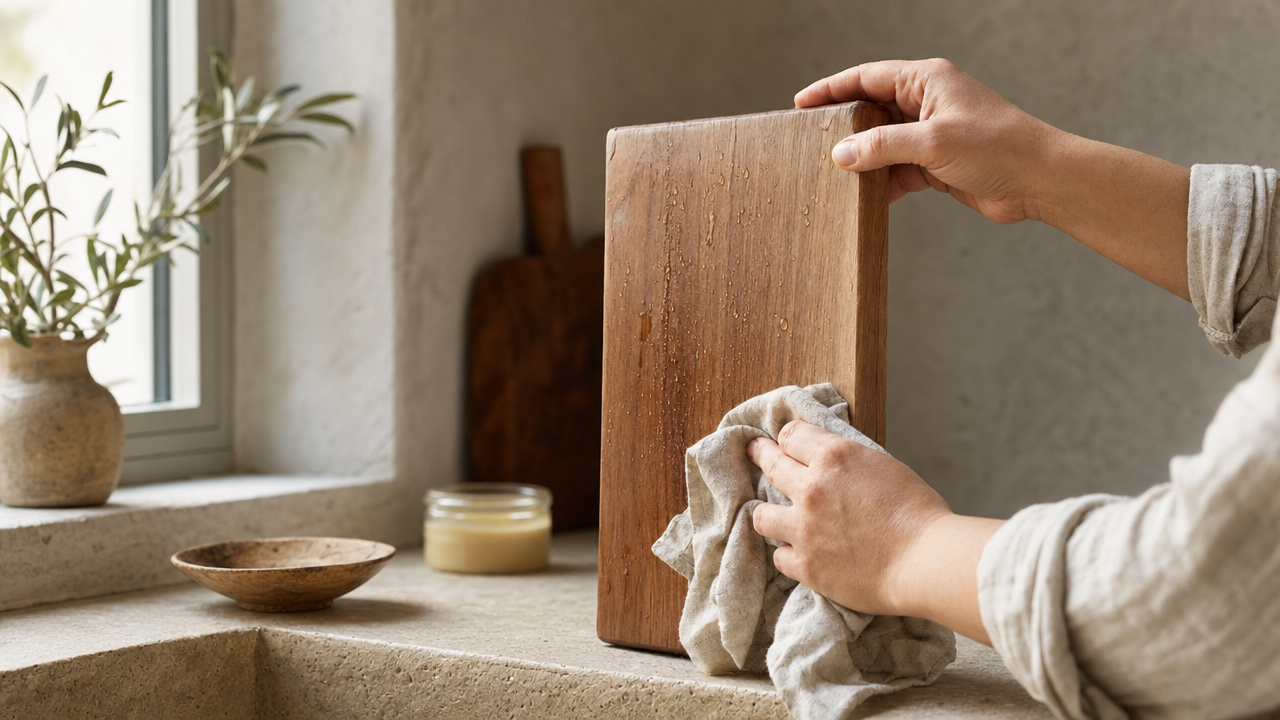
Wash a wooden cutting board by hand in warm soapy water right after you use it. Dry it with a towel. Stand it on its edge so air gets to both sides. Oil it about once a month if you use it every day, or every two to three months if you use it rarely. Keep it out of the dishwasher and out of a sink full of water. Those five habits decide almost everything that happens to the board later.
Almost everything that ruins a wooden board comes back to water, and it happens in two ways. Wood shrinks and splits when it gets too dry. Wood bends when one side takes on or loses water faster than the other. Cracks, bending and mould all start in one of those two places. So the whole routine has one job: keep the board from drying out, and keep both sides in the same state. Woodsea says a board looked after on a regular schedule should not crack at all. That puts most early damage down to how the board was treated, not to the wood it was made from.
What does daily care for a wooden cutting board involve?
Daily care for a wooden cutting board is three steps: wash it, dry it, stand it up. Wash it with warm water and a mild washing-up liquid right after you use it. Dry the whole surface with a towel instead of leaving it to drip. Then stand it upright so air gets to both sides. Never leave a wooden board soaking in the sink. Never leave water sitting on one side of it.
Woodsea gives the same instruction on its board product pages: wash with warm soapy water right after use, rinse, dry fully with a clean towel, then oil once a month.
Washing it straight away is the part people skip. A board washed a minute after you finish chopping barely takes on any water. A board left in the sink until after dinner has already taken water in, and it gives that water back unevenly through the evening. One side dries in the air, the other side sits flat on the worktop. That is how a board ends up bent.
How often should you oil a wooden cutting board?
Oil a wooden cutting board about once a month if you use it every day. Every two to three months is enough if it lives in a drawer and comes out at weekends. Oil it sooner if the surface looks dull, pale or chalky after it dries, because that means the last coat has worn off.
Oil does the real work. It fills space that water would otherwise take, so the board takes on and loses water more slowly. That matters because a board bends when one side changes faster than the other. Oil also stops the board drying out to the point where it splits. A board that gets oiled on time rarely needs flattening or sanding at all.
New boards drink a lot of oil. Expect the first few coats to soak straight in, and expect the gap between coats to get longer over the first few months.
What should you oil a wooden cutting board with?
Use a food-safe wood conditioner or food-grade mineral oil. Woodsea's board pages name food-grade mineral oil or a special cutting board oil. The workshop finishes its own boards with a certified mineral oil, but you do not need to buy that at home. A monthly coat of Wood Butter covers it. Wood Butter is hand-mixed from natural beeswax and refined mineral oil, and it was EUR 14.50 on 2026-08-11. The beeswax in it stays closer to the surface than plain oil does.

Never use a cooking oil that can go off. Woodsea's own care guide rules out olive oil and sunflower oil for that reason. A 2018 15min.lt guide still tells people to rub a board with olive oil, and that advice is out of date. Cooking oils go rancid inside the wood. The board ends up smelling sour and feeling sticky, and the only way to fix it is to sand it. Mineral oil and beeswax do not go off, which is why they became the standard for kitchen wood.
What does a dishwasher actually do to a wooden cutting board?
No wooden cutting board should go in a dishwasher. Woodsea says a board can split into several pieces, change colour, bend or go mouldy in there. A split board and mould that has got inside the wood are the two things you cannot fix. No wooden board in the Woodsea range is dishwasher safe.
Here is why. A dishwasher soaks the wood, heats it, then dries it fast, and wood only copes with slow changes. Appliance maker Candy says a normal dishwasher cycle runs at 45 to 65 degrees Celsius, with intensive programmes reaching 70, and glass or delicate programmes below 40. The wood swells while it soaks, then gets force-dried hot. If the board is glued together from several pieces, the same cycle works on the glue lines too.
The same logic rules out three other things people do without thinking: leaving a board in a full sink, holding it under a hot tap for a long time, and storing it flat on a wet worktop.
How do you clean a wooden cutting board after raw meat or poultry?
Clean it straight away with hot water and washing-up liquid. Scrub the whole surface and the edges, not just the spot you cut on. Rinse it, dry it at once with a towel, then stand it upright so air gets to both sides. Do not soak it and do not put it in the dishwasher.
This is Woodsea's own instruction for its boards. It matches the United States Department of Agriculture, which tells home cooks to wash boards in hot soapy water after each use, rinse, and air dry or pat dry. The edges matter more than people think. Juices run off the top of the board, sit on the edge where nobody looks, and dry there.
If raw meat has left deep cuts or cracks you cannot get clean, washing is no longer enough. The board needs sanding or replacing.
How many cutting boards does a kitchen actually need?
Two. One for raw meat and poultry, one for food you eat raw or do not cook again. Woodsea says you do not need a separate board for every type of food, and that one bigger good board handles most daily work. The second board is there for one reason: to keep raw meat away from food that never gets cooked. The United States Department of Agriculture says the same thing, and recommends one board for fresh produce and a separate one for raw meat, poultry and seafood.
Size matters more than count. A board that is too small pushes the chopping onto the worktop, and then people go back to the meat board because it is the only one big enough. Which sizes stop that, and what the second board should be, are covered in the Woodsea guide to choosing a wooden cutting board.
Why do wooden cutting boards crack or warp?
A board cracks when the wood either dries out too far or takes on far too much water. It bends when one side holds more water than the other. Woodsea says a board looked after on a regular schedule should not crack at all, so a crack usually means the routine slipped or the board got soaked once.
Bending has a name: cupping. It is the same process as cracking, caught at an earlier stage. The drier side shrinks, the wetter side does not, and the board pulls into a curve. That is why a board left flat on a wet worktop, or dried on one side by a radiator, ends up rocking on the counter.
The same few habits prevent all of it. Wash it quickly, dry both sides, stand it on edge, oil it monthly, and keep it away from direct heat and standing water.
How do you flatten a warped wooden cutting board?
Turn the board over and leave it overnight. The bend should even itself out. Turning it puts the side that was against the worktop into open air, and both sides move back to the same level of moisture.
If one night is not enough, flip it again and leave it longer. A board that will not settle after a few flips can be sanded flat instead, which is covered below.
How do you get onion, garlic or fish smell out of a wooden board?
Rub the surface with half a lemon or with lemon juice, scatter coarse salt over it, leave it a few minutes, then wash with warm water and dry it at once. Woodsea publishes this salt and lemon method as the deep-clean step for its boards.
Smell is mostly a timing problem. A board washed and dried right after you cut an onion rarely holds the smell at all. A board left overnight has given the oils time to soak in, and by then you are removing a smell instead of preventing one.
If it does not work the first time, repeat it rather than leaving it on longer. Lemon juice and salt sitting on a board for an hour just put acid and water into the wood, which is the last thing the board needs.
How do you remove beetroot, turmeric or red wine stains from a wooden board?
Act fast and start with warm water and a mild washing-up liquid, because most fresh colour lifts before it sets. If colour is still there after washing, rub the spot gently with a paste of baking soda and water, or with lemon and coarse salt. Then rinse, dry it at once, and re-oil the spot once the wood is fully dry.
Woodsea is clear that speed decides the result with beetroot, turmeric and wine. Strong colours that sit on a board overnight can leave a shadow that never fully goes.
A faint stain on a board you work on is only a cosmetic problem. If it bothers you, sanding takes it out.
Can you sand and re-oil a scarred cutting board?
Yes. A wooden board that is scratched, stained or rough can be sanded flat and re-oiled. This is the main practical advantage a wooden board has over a plastic one. How many times you can do it depends on how thick the board is.
Thickness is what you sand away later. Woodsea's oak Classic board is 1.5 cm thick in the small size and 2 cm in the large one, and the thicker Chop-chop sizes go up to 3 cm. Stop sanding when the board starts to feel bendy or no longer sits steady on the worktop.

Work from rough paper to fine. Start around 80 to 100 grit to take out deep knife marks and finish around 220 to 320 for a smooth surface, the way board refinishers describe it. Sanding strips the finish off, so the board needs a generous re-oiling afterwards, coat after coat until it stops soaking them up.
Is a cheap wooden cutting board worth buying?
A cheap wooden board is fine for light or occasional use. It is a poor buy as the board you cook on every day. Woodsea puts the difference in four places: the wood, how it is put together, how it is finished, and how long it lasts.
That difference changes how much care the board needs, which is why it belongs in a care guide. A thin board made from poorly dried wood punishes every small mistake, so one night flat on a wet worktop shows up as a bend. A thick, well-dried hardwood board takes the same mistake and lets you sand it out later. What those four differences are worth in money, and how to check each one before you pay, are covered in the Woodsea guide to choosing a wooden cutting board.
When should you replace a wooden cutting board?
Replace a wooden board when it has cracked, when mould has taken hold, or when it has deep grooves you cannot get clean. Woodsea says cracked and mouldy boards should be taken out of use, and that a board with deep cuts you can no longer clean out should be sanded down or replaced.
Age on its own tells you very little. How the board was treated matters far more than how old it is. The United States Department of Agriculture applies the same test to every kind of board, and says to throw a board out once it is badly worn or has grooves you cannot clean, because food stuck in a groove you cannot reach is the real risk.
Oak, ash, walnut, maple or pine: which wood is best for a cutting board?
For a board you use every day, pick a hardwood: oak, ash, walnut or maple. All four are much harder than pine on the Janka scale, which measures how well a surface resists denting, and hard maple is the hardest of the four. Pine dents and takes deep cuts quickly, so it suits serving and light jobs.
Care only changes by wood in one place. Oak has open pores, so drying it quickly and oiling it on time matter most there. The other hardwoods take the same monthly routine. The full comparison, with the hardness numbers and what each wood costs, is in the Woodsea guide to choosing a wooden cutting board.
One name in the range is worth knowing before you shop. The board sold as "Cutting board - Pine" is made of maple, because Pine there is the name of the design. The Burned pine board is the one that is actually pine.
Does a board with a leather handle need different care?
The wood gets the same care as any other board. Woodsea's Chop-chop board is oak with a leather handle, from EUR 32.49, and the oak follows the normal routine: wash it in warm soapy water right after use, dry the whole surface with a towel, stand it on edge, and oil it about once a month.

Dry the leather along with the board and keep it out of standing water.
Is a wooden cutting board more hygienic than a plastic one?
On bacteria, a wooden board is level with plastic or better, and how you clean it decides the result either way. A 2025 study in the Journal of Food Protection found E. coli on sugar maple boards dropping to the detection limit within two hours with no cleaning at all. Public health advice still sends raw meat to plastic, because a plastic board can be disinfected on a set schedule.
Neither the research nor the public health advice gets you out of the routine on this page. Wood only holds that advantage while it dries quickly and has no grooves you cannot clean, and that is exactly what daily drying, monthly oiling and sanding on time give you.
FAQ
Can you put a wooden cutting board in the dishwasher?
No. A dishwasher soaks the board and adds heat and detergent. Appliance maker Candy says a normal dishwasher cycle runs at 45 to 65 degrees Celsius, with intensive programmes reaching 70. Woodsea says a board can split into several pieces, change colour, bend or go mouldy. Wash wooden boards by hand and dry them straight away.
Can you use olive oil on a wooden cutting board?
No. Olive oil, sunflower oil and other cooking oils go rancid inside the wood and leave the board smelling sour and feeling sticky. Woodsea's own care guide rules out olive and sunflower oil. Use a food-safe wood conditioner such as Woodsea's Wood Butter, made from beeswax and refined mineral oil, or plain food-grade mineral oil.
How do you disinfect a wooden cutting board at home?
Wash it with hot water and washing-up liquid right after use, scrubbing the whole surface and the edges. Rinse it, dry it at once with a towel, and stand it upright. The United States Department of Agriculture recommends hot soapy water after every use, for every kind of board. Household disinfectants, how much to dilute them, and what the research says about wood's own effect on bacteria are covered in the Woodsea guide to whether a wooden cutting board is hygienic.
Does baking soda clean a wooden cutting board?
Baking soda works as a mild abrasive on colour stains. Mix it with a little water into a paste, rub the stain gently, rinse and dry at once, then re-oil the spot once the wood is fully dry. Use it on stains only, and keep it out of the daily wash.
Should you oil a new wooden cutting board before first use?
Yes, and expect the first coats to soak straight in. New wood takes more oil than settled wood, so several coats over the first few weeks are normal before the board settles into a roughly monthly rhythm.
How long does a wooden cutting board last?
It depends almost entirely on how it is treated and how it was made. A thick, properly dried hardwood board that is washed quickly, dried upright, oiled monthly and sanded when it gets scratched can last many years, and Woodsea says such a board can be sanded and renewed when the surface wears. A thin board made from softer or poorly dried wood bends and cracks far sooner.
Is it safe to keep using a cracked wooden cutting board?
No. Woodsea says cracked and mouldy boards should be taken out of use. A crack holds food and water in a place you cannot clean or dry, and that is what grows mould inside the board.
Can you use the same board for meat and vegetables if you wash it between?
It is safer to keep a separate board for raw meat and poultry. The United States Department of Agriculture recommends one board for produce and another for raw meat, poultry and seafood, because anything a wash misses can reach food that never gets cooked.
How do you store a wooden cutting board?
Stand it on its edge, or keep it in a rack where air gets to both sides. Storing a board flat on a worktop traps water underneath, and that is one of the most common reasons boards bend. Keep it away from radiators, ovens and direct sunlight, which dry one side faster than the other.
About Woodsea
Woodsea is a Lithuanian workshop making handmade wooden kitchenware: cutting, serving and butcher boards, knife holders, grinders and home objects, in oak, ash, walnut, maple and pine, with food-safe finishes. Boards ship from stock. The range is at woodsea.studio, and board care products including Wood Butter are in the same store.