

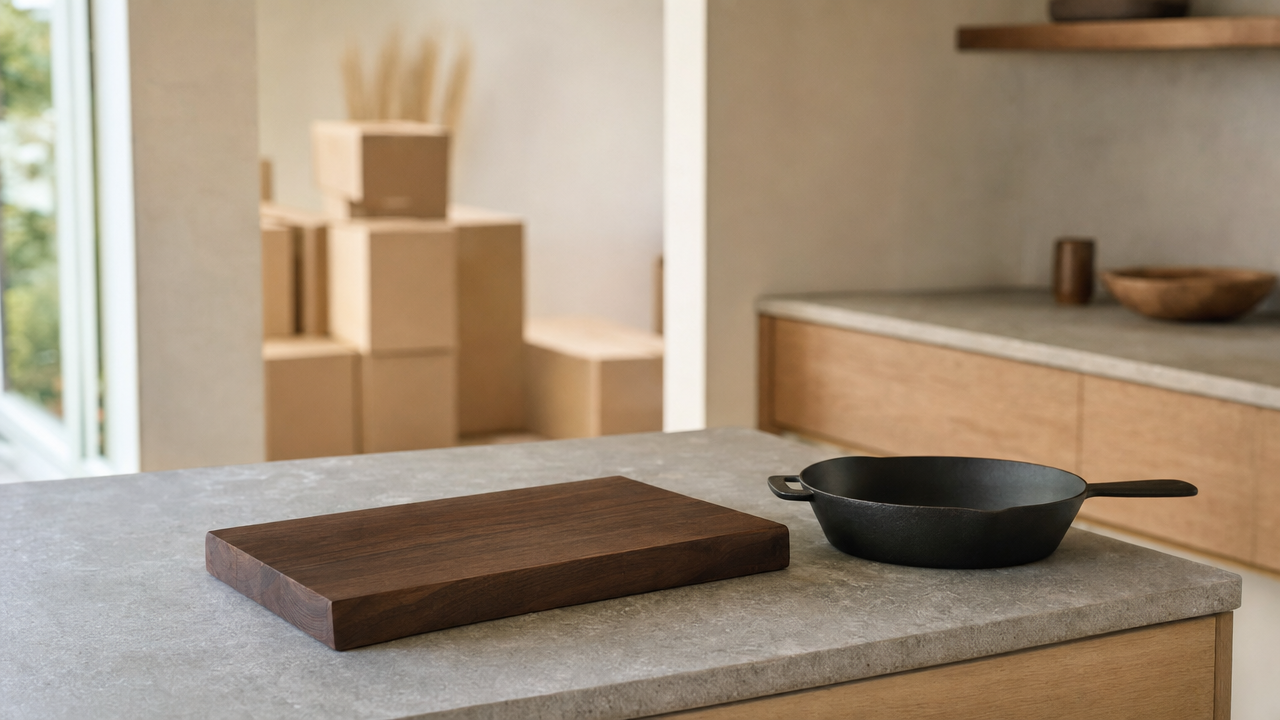
A new kitchen needs ten things in the first week. Five more can wait until you know how you actually cook.
Buy right away: one chef's knife, a paring knife and a bread knife. Then two cutting boards, board oil or wax, one frying pan, one saucepan and one large pot. Then mixing bowls with a colander, tongs, a heat-proof spatula and a wooden spoon, wall storage for the knives and a food thermometer.
Leave for later: the knife set in a block, the second and third pan, serving boards and trays, a stand mixer, and the single-job gadgets.
Most of this can be bought in one afternoon from a large general retailer such as IKEA. The wooden part of the list comes from a workshop and takes a few days longer. Woodsea makes cutting boards, knife holders and grinders. On the cheapest lines the whole buy-now list comes to about 143 EUR, and the price table further down gives every range behind that figure.
The 15 items at a glance
Buy right away:
- One chef's knife
- A paring knife and a bread knife
- Two cutting boards
- Board oil or wax
- One frying pan
- One saucepan and one large pot
- Mixing bowls, a colander and measuring spoons
- Tongs, a heat-proof spatula and a wooden spoon
- Wall storage for the knives
- A food thermometer
What can wait:
- The knife set in a block
- The second and third pan
- Serving boards and trays
- A stand mixer or a food processor
- Single-job gadgets and one-dish boards
After the list: what the buy-now list costs and where to buy kitchen tools and accessories.
Buy right away: the ten things you use in the first week
Every item in this half gets used in the first week of cooking, and each one is worth buying on its own. The order below is roughly the order you will reach for them.
1. One chef's knife
One chef's knife with a blade around 20 cm long does most of the cutting in a home kitchen. It chops onions, joints a chicken, slices cabbage and flattens garlic. You will pick it up every single day.
Reviewed says the 8 inch Victorinox Fibrox Pro is "well balanced, comfortable to use, and is our pick for the best value chef's knife".
Fiskars and Zwilling sit on the same shelf at a similar level. Between a cheap knife and a mid-range one, what changes is how long the edge lasts. The other difference is how the handle sits in your hand after twenty minutes of prep.
2. A paring knife and a bread knife
Two more knives cover what the chef's knife does badly. A paring knife handles garlic, small fruit and anything you hold in your hand. A serrated bread knife cuts crusty bread and ripe tomatoes without squashing them.
Buy them one at a time. IKEA sells both under its own name, and Tescoma, Fiskars and Victorinox sell them as single knives.
3. Two cutting boards
Buy two boards: one large wooden board for food that reaches the plate uncooked, and a cheap plastic one for raw meat, poultry and fish. Raw meat goes on the plastic board because wood is harder to clean thoroughly once it has touched raw chicken or fish.
The University of Maine Cooperative Extension sets out that split: "To help reduce cross-contamination, consider using separate cutting boards: one for raw animal products (such as meat, poultry, or seafood) and another for ready-to-eat foods".
The same page also picks the materials, and it is harder on wood than a wood workshop would like. It puts raw meat, seafood and poultry on plastic, and keeps wood for "lower-risk foods such as vegetables, fruits, and bread, since wood can be more difficult to sanitize thoroughly after contact with raw meat or seafood".
So two boards go in the trolley on Saturday. The wooden one does the daily work: bread, cheese, salad, fruit and vegetables. The plastic one comes out for chicken and then goes through the dishwasher, which a wooden board cannot take.
One large wooden board covers most of a household's daily cutting. The second board on this list is the plastic one, for raw meat. Woodsea's cutting boards are mostly oak, ash and walnut, with a maple line and one board in thermally modified ash. The range runs from 17.49 EUR for the smallest boards to 350 EUR for the largest.
4. Board oil or wax
A wooden board needs oiling about once a month. Buying the oil at the same time as the board saves you the month where you mean to and forget.
The University of Maine bulletin gives the method: "Apply a food-safe mineral oil or beeswax approximately once a month". Rub it in with a cloth, let it soak for several hours or overnight, then wipe off what is left.
Wood Butter is Woodsea's version of that, at 14.50 EUR. It is beeswax blended with refined mineral oil, and it goes on once a month. Keep cooking oils away from the board. Olive oil and sunflower oil go off in the wood and start to smell, which is why Woodsea's own care guide rules them out.

Washing matters as much as oiling. The one thing the University of Maine holds against wood is that it takes on moisture and bacteria when it is not looked after. So wash the board straight away in hot water with washing-up liquid. Scrub the whole surface and the edges, rinse, dry it at once, then stand it up so air reaches both sides. Never soak it and never put it in the dishwasher.
How much upkeep a board asks for depends on its wood. Of the four woods Woodsea compares for boards, oak is the hardest and takes heavy daily chopping. Its pores are open, so an oak board needs its monthly oiling kept up. Ash is close behind and a little springier, which makes it a good all-round board.
Walnut is softer, kinder to a blade and shows cuts sooner. Pine is softer again and picks up deep gouges quickly, which is why a board in heavy use is better in hardwood.
A worn board can be brought back. When the surface is scored and dull, sand it back and re-oil it rather than throw it out. Replace it only when there are cuts you can no longer get clean.
5. One frying pan
Buy one frying pan that you will use every day, and buy it by itself. The Academy of Nutrition and Dietetics is blunt about the alternative: "Instead of buying a large, expensive set to start, purchase individual pans as you need them".
One medium pan handles eggs in the morning and two portions of meat in the evening. IKEA's own pans are the cheap entry point. Tefal is the standard non-stick answer. Cast iron is heavy and very hard to damage, and some people never warm to the weight.
Check the hob before you pay. An induction hob only heats a pan with a magnetic base.
6. One saucepan and one large pot
A saucepan for sauces, porridge and small amounts of rice. A large pot for pasta, potatoes and soup. Those two cover almost everything a household cooks in its first year.
IKEA and Tescoma both sell single pots, which keeps the first purchase small. Check that each one comes with a lid that fits it.
Look at the base. A thin base scorches sauces and burns porridge onto the bottom.
7. Mixing bowls, a colander and measuring spoons
You need something to mix in, something to drain into and something to measure with. Buy bowls in more than one size, and buy the sort that stack. Nesting bowls take one shelf instead of three.
A colander drains pasta, rinses vegetables and washes lentils. IKEA, Brabantia and Joseph Joseph all sell nesting bowl and colander sets.
Measuring spoons are the cheapest item on this whole list.
8. Tongs, a heat-proof spatula and a wooden spoon
Three tools do the moving. Tongs lift and turn food over heat and reach into a hot oven without putting your hand near the shelf. A heat-proof silicone spatula scrapes a pan clean without scratching the coating. A wooden spoon stirs without getting hot in your hand and without marking the pot.
Small workshops make wooden spoons and spatulas to order. Fiskars and Tescoma cover the plastic and steel versions in every supermarket.
9. Wall storage for the knives
Put the knives on the wall in the first week. A knife dropped loose into a drawer knocks against forks and other blades. That is where a new edge goes first.
Woodsea's knife holders are oak or walnut, with magnets hidden inside the wood. The cheapest of them, Hold my knife, is 49.99 EUR and comes with 3M VHB adhesive tape, so it goes up without drilling. That matters if you rent, and it matters if the wall is tiled.
IKEA's KUNGSFORS steel magnetic rack does the same job for 19.99 EUR.
10. A food thermometer
A thermometer is small, cheap and the only safety item on this list. The Academy of Nutrition and Dietetics states it plainly: "A food thermometer is the only way to make sure foods have been cooked to the appropriate internal temperature".
Chicken, pork and a large roast are where guessing costs you. A digital probe thermometer is one of the cheapest things you can put in a kitchen drawer.
What can wait: the five things people buy in week one and use twice a year
Each of these turns up in almost every new kitchen. Each one is easier to choose after a few months of cooking, when you know which version you need.
11. The knife set in a block
A block set is the most common first-week purchase and the one with the worst hit rate. A five-piece set puts five knives on your worktop, and the honest question is whether you will reach for more than three of them.
Buy the block once you know which knives your hand goes to. By then you will also know where you want them: a wooden block, a magnetic wall holder or a drawer insert.
If someone gives you a set as a housewarming present, keep it.
12. The second and third pan
Buy the second pan when the first one stops being enough. A wok, a grill pan and a small sauté pan all earn their place eventually. Each one earns it on the day a specific recipe asks for it.
A set of four pans costs less than the same four bought one at a time. The catch is that one of the four is usually a size nobody in the house uses.
13. Serving boards and trays
Serving pieces are the least urgent purchase on this list. Buy them in the second round, once you know how you host.
A tray for six people at a table is a different object from a tray for twelve people standing with a glass in one hand.
Woodsea's serving boards and serving trays come out of the same workshop as the cutting boards.
14. A stand mixer or a food processor
A KitchenAid or a Smeg mixer is a beautiful machine that occupies a permanent square of worktop. It earns that square if you bake most weeks. If you bake at Christmas, it is a Christmas purchase.
A hand mixer is far cheaper, fits in a drawer and whips cream just as well.
15. Single-job gadgets and one-dish boards
The garlic press, the avocado tool, the egg slicer, the herb chopper and the spiralizer all solve one job that a chef's knife already solves.
The same logic covers one-dish boards. Woodsea makes pizza boards and sushi boards, and both are worth buying once Friday night has been pizza night for a while.
What the buy-now list costs
At the entry level the whole buy-now list comes to about 143 EUR, read on 2026-08-25. In mid-range named brands the same list runs to roughly 360 to 445 EUR.
The list has ten items and the table has more rows than that, because some of those items are more than one object: the pair of small knives, both boards, and the three moving tools. Two rows count more than once. The pot row counts twice, since the list asks for a saucepan and a large pot, and the bowl row counts three times, since bowls are bought in a few sizes.
| Item | Entry level | Mid range |
|---|---|---|
| Chef's knife, 20 cm blade | from 10 EUR | 45 to 50 EUR |
| Paring knife, 8 to 11 cm blade | from 1.50 EUR | 7 to 13 EUR |
| Bread knife, serrated | from 10 EUR | 36 to 40 EUR |
| Wooden cutting board, large | from 40 EUR | 45 to 75 EUR |
| Plastic board for raw meat | from 3 EUR | about 15 EUR |
| Board oil or wax | 14.50 EUR | 14.50 EUR |
| Frying pan, 24 cm | from 5 EUR | 40 to 45 EUR |
| Saucepan or large pot with lid, each | from 10 EUR | about 20 EUR |
| Mixing bowl, each | from 1 EUR | about 10 EUR |
| Colander | from 4 EUR | 10 to 25 EUR |
| Tongs, spatula and wooden spoon, all three | from 4 EUR | 15 to 25 EUR |
| Wall storage for the knives | from 20 EUR | about 50 EUR |
| Digital probe thermometer | from 8 EUR | 15 to 23 EUR |
Every range above came from live category and product pages, and promotions move them.
Three things about that entry-level column are worth saying out loud. The wooden board is priced as a large one, since that is the board this list asks for. Woodsea sells small boards from 17.49 EUR, and the cheapest large ones in stock start around 40 EUR.
The board wax is the only row with one fixed price instead of a range, because it is one specific product. Any food-safe mineral oil does the same job, so 14.50 EUR is a choice rather than a floor. At the entry level it is still the most expensive single thing on the list, which is what happens when everything else is bought on the cheapest line.
Measuring spoons have no row of their own, because they sit under a couple of euros wherever you shop.
The same categories keep going well above the mid range. Forged knives start around 170 EUR and heavy clad pans around 90 EUR. Copper pots run into the several hundreds. Large wooden boards in end grain reach 190 to 350 EUR.
Board oil is a running cost. Wood Butter is 14.50 EUR and a wooden board wants it once a month.
Where to buy kitchen tools and accessories
Kitchen tools and accessories come from three kinds of seller. A large general retailer such as IKEA covers the basic kit in a single trip at the lowest price. An online marketplace carries the brand range. A workshop makes the wooden pieces itself and sells them direct.
Woodsea's own terms, if you want the wooden half of the list from one place: the studio is in Vilnius. An order is processed in one to two days. Delivery inside Lithuania is free over 90 EUR. Shipping abroad takes five to seven days with DHL. Woodsea also sells ready-made bundles, so a board and a knife holder come as one purchase.
FAQ
What kitchen items should you buy when fitting out a new kitchen?
Ten things: three knives (chef's, paring, bread), two cutting boards with board oil, one frying pan, one saucepan and one large pot. Then mixing bowls and a colander, tongs, a spatula and a wooden spoon, wall storage for the knives and a food thermometer. The knife block set, the extra pans, serving boards, a stand mixer and single-job gadgets can wait until you know how you cook.
Where can you buy kitchen tools and accessories?
Three kinds of seller cover this list. A large general retailer such as IKEA has the basic kit in one trip at the lowest price. An online marketplace carries the brand range, including Victorinox, Fiskars, Zwilling, Tescoma, Brabantia and Joseph Joseph. A workshop makes the wooden pieces: Woodsea makes cutting boards, magnetic knife holders and grinders. A Woodsea order is processed in one to two days, ships free inside Lithuania over 90 EUR, and reaches other countries in five to seven days with DHL.
How much do the basics for a new kitchen cost?
About 143 EUR at the entry level, or roughly 360 to 445 EUR in mid-range named brands. That covers the whole buy-now list: three knives, two cutting boards, the board wax, a frying pan, a saucepan and a pot, bowls with a colander, tongs and a spatula and a wooden spoon, wall storage and a probe thermometer. The wooden board is priced as a large one, since that is the board the list asks for.
How many cutting boards does a home kitchen need?
Two. The University of Maine Cooperative Extension advises one board for raw animal products such as meat, poultry or seafood and another for ready-to-eat foods. One large wooden board covers most daily work, and the second board is the minimum a home needs, because it keeps raw chicken away from the bread.
Can a wooden cutting board go in the dishwasher?
Woodsea says no. A wooden board that goes through a dishwasher can split into pieces, change colour, grow mould or bend out of shape. The University of Maine Cooperative Extension is softer on this and says solid wood boards may be OK in some dishwashers, though some may warp. Washing by hand and drying the board standing up avoids the question.
How often should you oil a wooden cutting board?
About once a month. The University of Maine Cooperative Extension recommends applying a food-safe mineral oil or beeswax approximately once a month, rubbing it in, letting it soak for several hours or overnight and wiping off the excess. Woodsea's Wood Butter, at 14.50 EUR, is beeswax with refined mineral oil and is used on the same monthly schedule.
About Woodsea
Woodsea is a Lithuanian workshop making wooden kitchenware by hand: cutting and serving boards, magnetic knife holders, salt and pepper grinders, candlesticks, lamps and clocks. The woods in the range are oak, ash, walnut, pine and maple. Woodsea trades as Rio Lindo gifts, UAB, Dumu g. 3, Vilnius.